
Published
31 December 2025
Author
@Mark Lewis
Stress, Recovery, and the Nervous System
Why HRV matters and how to train recovery
Overview
Stress is a normal and necessary part of life. Physical training, mental effort, work demands, and emotional challenges all represent forms of stress.
Health and performance depend not on avoiding stress, but on the body’s ability to recover from it.
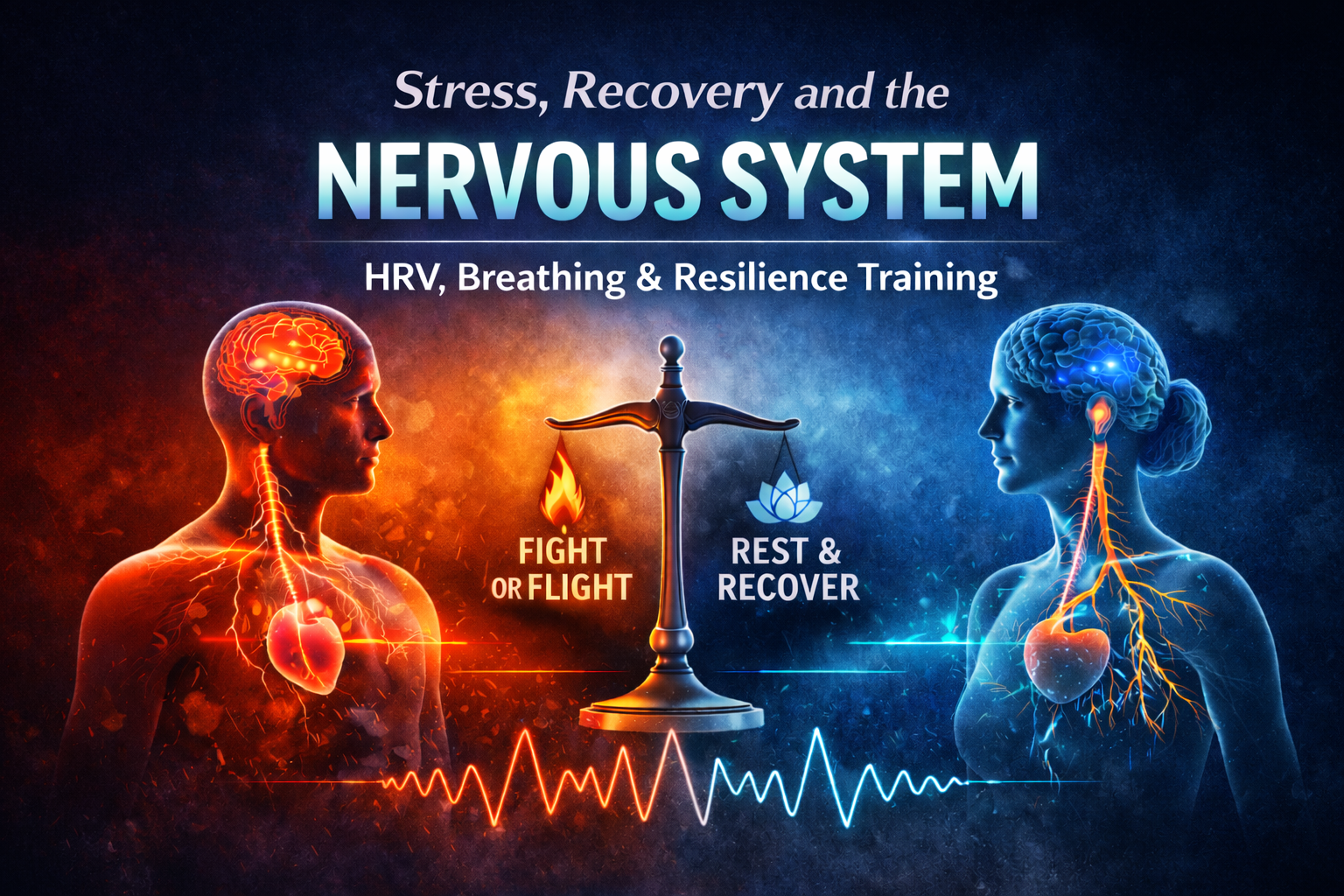
At the centre of this balance is the autonomic nervous system — the system that regulates heart rate, breathing, hormones, digestion, and sleep. One of the most useful ways to assess and influence this system is through Heart Rate Variability (HRV).
Stress vs Recovery: A Physiological Perspective
The autonomic nervous system has two primary branches:
-
Sympathetic nervous system
Activates alertness, focus, mobilisation, and energy output
-
Parasympathetic nervous system
Supports rest, digestion, repair, immune function, and recovery
Healthy physiology involves flexible movement between these states.
Chronic stress occurs when:
- Sympathetic activation becomes dominant
- Parasympathetic recovery is insufficient
- The nervous system loses flexibility
This is where HRV becomes clinically useful.
What Is Heart Rate Variability (HRV)?
Heart Rate Variability refers to the small, natural variation in time between heartbeats.
A healthy heart does not beat with perfect regularity. Instead, it dynamically adjusts based on breathing, movement, emotions, and metabolic demand.
In general:
- Higher HRV reflects greater adaptability and recovery capacity
- Lower HRV reflects higher physiological stress or reduced resilience
Trends over time matter far more than individual readings.
Why HRV Is Central to Stress & Recovery
HRV functions as a global signal of system load versus system capacity.
Research consistently links healthier HRV patterns with:
- Improved stress tolerance and emotional regulation
- Better sleep quality
- Improved cardiometabolic health
- Enhanced exercise recovery
- Reduced burnout and fatigue risk
In this sense, HRV does not measure stress itself — it reflects how well the body is coping with stress.
What Is HRV Training?
HRV training (also called HRV biofeedback) is a structured breathing practice designed to improve autonomic balance.
It typically involves:
- Slow, paced breathing
- Approximately 5–6 breaths per minute
- Nasal, diaphragmatic breathing
- A calm, unforced rhythm
- Optional feedback via a wearable or app
This breathing pattern aligns with the body’s natural resonance frequency, enhancing communication between the heart, lungs, blood vessels, and brain.
Over time, HRV training improves the nervous system’s ability to:
- Exit stress states
- Recover efficiently
- Maintain physiological flexibility
How HRV Training Works (Simplified)
HRV training primarily stimulates the vagus nerve, the main parasympathetic nerve connecting the brain, heart, lungs, and gut.
Key effects include:
- Improved blood pressure regulation
- Reduced baseline stress hormone output
- Improved heart–breath coordination
- Greater top-down regulation of stress responses
Put simply, HRV training teaches the nervous system how to recover on demand.
How to Start HRV Training
A practical checklist
Time:
Morning (before caffeine) or evening (1–2 hours before bed)
Duration:
5 minutes daily → progress to 8–10 minutes
Position:
Seated or lying comfortably, spine neutral
Breathing:
- Nasal breathing only
- Inhale ~4 seconds
- Exhale ~6 seconds
- Relaxed, unforced rhythm
Focus:
Calmness and consistency, not performance
Stop if:
Lightheadedness, air hunger, or anxiety occurs
Common Early Responses
Signs that HRV training is working may include:
- Slower heart rate
- Warmth in hands or face
- Yawning or sighing
- Improved sleep onset
- Subtle mental clarity
These reflect parasympathetic activation and are normal.
Using Wearables to Support HRV Training
Wearables are tools for awareness and trend tracking, not judgment.
Apple Watch
- Measures HRV intermittently (SDNN)
- Best used for overnight trend monitoring
- Use the Breathe/Mindfulness app for practice
Oura Ring
- Measures HRV overnight (RMSSD)
- Highly stable recovery trends
- Review HRV the morning after training
WHOOP
- Measures HRV overnight (RMSSD)
- Integrates HRV into recovery scores
- Useful for training load decisions
Key principle:
Train HRV during the day → review trends weekly or monthly.
What HRV Training Is Not
HRV training is not:
- A substitute for sleep, nutrition, or exercise
- A treatment for structural heart disease
- A competition for higher scores
- A quick fix for chronic illness
It is a foundational recovery skill that supports all other interventions.
Key Takeaway
Stress is unavoidable. Recovery is trainable.
HRV training provides a simple, low-risk, evidence-informed way to:
- Improve nervous system flexibility
- Increase recovery capacity
- Support long-term health and performance
This is the foundation on which the rest of the Science of Stress & Recovery series is built.
Learn how stress affects the nervous system, why recovery matters, and how HRV training can improve resilience, sleep, and long-term health.
Learn how stress affects the nervous system, why recovery matters, and how HRV training can improve resilience, sleep, and long-term health.