
Published
2 March 2026
Author
@Mark Lewis
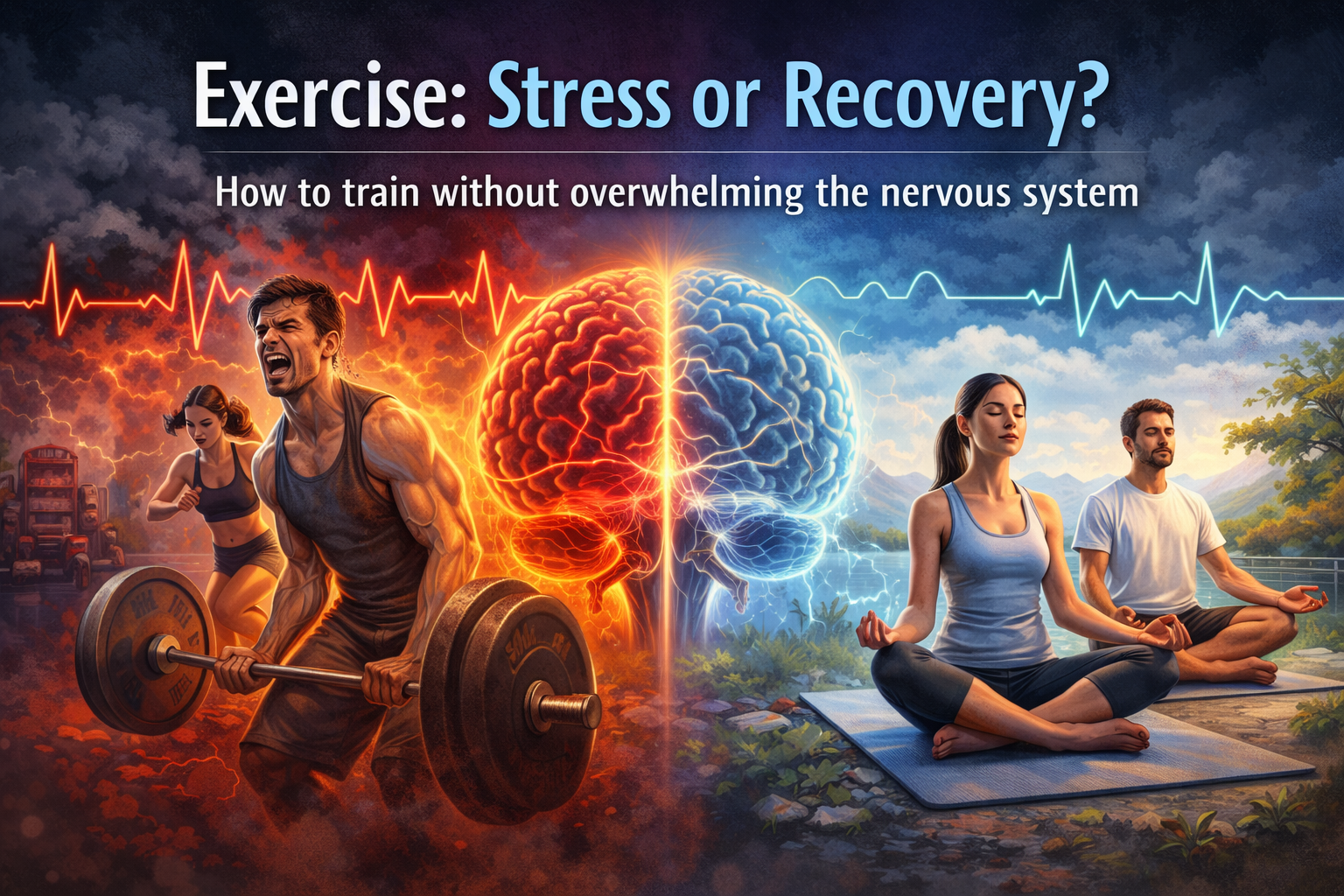
How to train without overwhelming the nervous system
Exercise is one of the most powerful tools we have for building a longer, healthier life. But here's the paradox that catches many people off guard: every workout is a form of stress. Push the right amount, and your body adapts — growing stronger, more resilient, more efficient. Push too hard, too often, without enough recovery, and exercise starts working against you. The difference between progress and breakdown often comes down to how well you manage your nervous system.
Understanding this balance isn't just for elite athletes. Whether you're training for a fun run, lifting weights three times a week, or simply trying to stay active as you age, knowing how your body responds to exercise stress — and how to recover from it — may be one of the most important things you learn on your health journey.
1. Exercise Is a Stressor (And That's the Point)
Every time you lace up your runners and push yourself through a workout, your body activates the same stress response it would use if you were being chased by a predator. Your sympathetic nervous system — the "fight or flight" branch — kicks into gear. Heart rate climbs, blood pressure rises, and your adrenal glands release stress hormones including cortisol and adrenaline (Armstrong et al., 2022).
This isn't a design flaw — it's a feature. The acute stress of exercise triggers a cascade of adaptations. Your muscles repair and grow, your cardiovascular system becomes more efficient, your mitochondria multiply, and your brain releases feel-good neurotransmitters. The technical term for this beneficial stress response is hormesis: a small dose of stress that triggers a disproportionately positive adaptive response.
The key word, though, is acute. A single challenging workout followed by adequate recovery is a stimulus for growth. But when that stress becomes chronic — when the body never gets the chance to fully recover — the equation flips. Instead of adaptation, you get breakdown.
How to apply this
- Think of exercise as a stimulus, not a punishment. The goal is to challenge the body enough to trigger adaptation, then rest long enough to let that adaptation happen.
- If you're consistently feeling worse after training rather than better within 24–48 hours, it may be a sign your nervous system needs more recovery time.
2. Your Autonomic Nervous System: The Master Switch
To understand why recovery matters so much, it helps to know a little about your autonomic nervous system (ANS). This is the control centre that runs the show behind the scenes — managing heart rate, breathing, digestion, immune function, and more — without you having to think about it.
The ANS has two main branches. The sympathetic nervous system (SNS) is your accelerator. It ramps up during exercise, work stress, conflict, or anything that demands energy and alertness. The parasympathetic nervous system (PNS) is your brake — it promotes rest, digestion, repair, and recovery, largely through the vagus nerve (Forte et al., 2019).
In a well-functioning body, these two branches work in dynamic balance. You rev up during a workout, then wind down afterward. The parasympathetic system takes over quickly, heart rate drops, blood pressure normalises, and recovery begins. Research shows that higher resting heart rate variability (HRV) — a measure of the beat-to-beat fluctuation in your heart rate — reflects stronger parasympathetic activity and greater capacity to handle stress (Kim et al., 2018).
When this balance is disrupted — when the sympathetic branch dominates for too long — recovery stalls, inflammation builds, sleep suffers, and performance declines. This is the nervous system equivalent of leaving your car engine running all night.
How to apply this
- Your nervous system doesn't distinguish between a hard gym session, a fight with your partner, and a looming work deadline. Total stress load matters, not just exercise stress.
- On days when life stress is high, consider dialling back your training intensity. Your nervous system will thank you.
3. The Overtraining Trap
Overtraining syndrome (OTS) is what happens when the balance between training stress and recovery tips too far in the wrong direction. It's more common than many people realise, and it doesn't only affect professional athletes.
Research from the Society for Endocrinology describes a pattern where repeated high-intensity training without sufficient recovery leads to a blunting of the body's normal hormonal responses to stress. Cortisol and testosterone responses become flattened, the hypothalamic-pituitary-adrenal (HPA) axis stops functioning optimally, and the athlete — or everyday exerciser — hits a wall (Cadegiani & Kater, 2019; Armstrong et al., 2022).
The symptoms are frustratingly vague: persistent fatigue, disrupted sleep, declining performance despite continued effort, mood disturbances, frequent illness, and loss of motivation. One review in Sports Psychiatry noted that overtraining syndrome and clinical depression share remarkably similar changes in brain structures, neurotransmitter levels, and immune responses (Reardon et al., 2023).
What makes OTS particularly insidious is that many people respond to plateauing performance by training harder, when the body is actually crying out for rest. The Cleveland Clinic describes a three-stage model of overtraining, progressing from initial overreaching to sympathetic nervous system dysfunction and, in the most severe cases, parasympathetic nervous system exhaustion (Cleveland Clinic, 2025).
How to apply this
- If your performance is declining despite consistent training, take a full rest week before adding more volume or intensity.
- Track subjective markers like sleep quality, motivation, mood, and resting heart rate. These often flag overtraining before performance drops do.
- Remember that non-exercise stress (work, relationships, poor sleep) counts toward your total stress budget.
4. The 80/20 Rule: How the World's Best Athletes Actually Train
One of the most counterintuitive findings in exercise science is how elite endurance athletes distribute their training. Research by sport scientist Dr Stephen Seiler at the University of Agder in Norway revealed that world-class endurance athletes across multiple sports — rowing, running, cycling, swimming, and cross-country skiing — consistently spend around 80% of their training time at low intensity (Seiler, 2010).
The remaining 20% is performed at high intensity. What's largely absent is training in the middle zone — that "comfortably hard" pace that many recreational exercisers default to. This approach has become known as polarised training or the "80/20 rule."
Why does this work? A landmark study by Seiler's group on trained runners found that parasympathetic nervous system recovery was extremely rapid after exercise performed below the first ventilatory threshold — even sessions lasting up to 120 minutes. But once intensity exceeded that threshold, autonomic nervous system recovery was significantly delayed (Seiler et al., 2007). In practical terms, the first ventilatory threshold appears to be a binary switch for nervous system stress.
The implication is profound: the majority of your training can build an enormous aerobic engine without significantly stressing your nervous system. The occasional hard session provides the high-intensity stimulus for further adaptation — but only if you're rested enough to actually push hard when it counts.
How to apply this
- For most people, 3–4 sessions per week should follow an easy conversational pace. You should be able to talk in full sentences during these sessions.
- Limit genuinely hard sessions to 1–2 per week. Make them count by arriving rested.
- Avoid the "grey zone" — sessions that are too hard to be truly easy, but not hard enough to stimulate high-intensity adaptations.
5. Zone 2: The Longevity Sweet Spot
If polarised training describes the broad framework, Zone 2 training is the engine that drives most of it. Zone 2 refers to a moderate intensity where your body relies primarily on fat for fuel and your mitochondria are working at their most efficient level — just below the point where lactate begins to accumulate (San Millán & Brooks, 2018).
Dr Peter Attia, a physician and longevity researcher, considers Zone 2 training one of the four essential "pillars of exercise" for maintaining health as we age. He and exercise physiologist Dr Iñigo San Millán describe Zone 2 as the intensity that produces the greatest improvements in fat oxidation, lactate clearance, and mitochondrial function — all of which are central to metabolic health and ageing (Attia & San Millán, 2020).
Since mitochondrial decline is considered a hallmark of biological ageing, strengthening mitochondrial function through consistent Zone 2 work may be one of the most accessible strategies for extending not just lifespan, but healthspan — the years spent in good health. Zone 2 training also improves insulin sensitivity, enhances cardiovascular efficiency, and supports a lower resting heart rate.
Perhaps most relevant to this article, Zone 2 training achieves all of this without meaningfully disrupting autonomic nervous system balance. It sits comfortably below the threshold that triggers significant sympathetic activation, meaning you can do it frequently without accumulating excessive nervous system stress.
How to apply this
- Aim for 3–4 hours of Zone 2 training per week. This can be walking, cycling, swimming, rowing — any sustained movement at a conversational pace.
- A simple self-test: if you can speak in full sentences but would rather not sing, you're likely in Zone 2.
6. Recovery Isn't Passive — It's Where the Magic Happens
There's a common misconception that fitness is built during the workout. In reality, the workout provides the stimulus; the adaptation happens during recovery. Muscles repair, mitochondria multiply, neural pathways consolidate, and the nervous system recalibrates — but only if you give it the time and conditions it needs.
Sleep is the single most important recovery tool. Research consistently shows that poor sleep elevates inflammatory markers, disrupts hormonal balance (including cortisol and growth hormone), and impairs autonomic nervous system function. Sleep deprivation is associated with elevated levels of pro-inflammatory cytokines in the brain, including IL-1β and TNF-α, which are counteracted by regular moderate exercise (Bhatt et al., 2015).
Nutrition is equally critical. Post-exercise recovery requires adequate protein to support muscle repair, carbohydrates to replenish glycogen stores, and micronutrients to manage the oxidative stress that exercise naturally produces. Antioxidant-rich whole foods support the body's built-in defence systems without blunting the adaptive signal of exercise (Nocella et al., 2019).
Active recovery — gentle movement like walking, easy swimming, or stretching — promotes circulation without adding significant nervous system stress. This helps clear metabolic waste products, reduces muscle stiffness, and maintains mobility between harder training sessions.
How to apply this
- Prioritise 7–9 hours of quality sleep per night, especially on training days.
- Eat a balanced meal containing protein and carbohydrates within a few hours of training.
- Include at least one full rest day per week. Active recovery (a gentle walk, some mobility work) counts — you don't need to be completely sedentary.
7. Mind-Body Practices: Training Your Recovery System
While most discussions about exercise focus on building fitness, there's growing evidence that certain movement practices are uniquely powerful at training the recovery side of the nervous system.
Yoga, tai chi, and qigong combine slow, controlled breathing with rhythmic movement and focused attention. A systematic review and meta-analysis of randomised controlled trials found that these mind-body practices significantly increase parasympathetic nervous system activity, reduce sympathetic dominance, and lower perceived stress (Zou et al., 2018).
The mechanism appears to involve stimulation of the vagus nerve — the main highway of the parasympathetic nervous system. Research suggests that yoga practices may correct underactivity of the parasympathetic system and the inhibitory neurotransmitter GABA (gamma-aminobutyric acid), essentially restoring the body's capacity to shift out of stress mode and into recovery mode (Streeter et al., 2012).
A pilot study published in Stress and Health found that combining paced breathing with rhythmic muscle contraction — as occurs naturally in practices like tai chi — produced 150% greater parasympathetic activation compared to a control group (Chin & Kales, 2019). This suggests that the combination of breath and movement, rather than either alone, may be what makes mind-body practices so effective for nervous system regulation.
For people who exercise intensely, incorporating a mind-body practice isn't a soft alternative — it's a strategic tool for accelerating recovery and improving stress resilience.
How to apply this
- Consider adding one yoga, tai chi, or guided breathwork session per week, especially on recovery days.
- Even 10–15 minutes of slow, diaphragmatic breathing after a workout may support a faster shift from sympathetic to parasympathetic dominance.
- Practices that emphasise a long, slow exhale are particularly effective at activating the vagus nerve.
8. Listening to Your Body: Practical Signals to Watch
Your body is constantly communicating how well it's handling your training load. Learning to listen to these signals is one of the most valuable skills you can develop.
Heart rate variability (HRV) has emerged as one of the most accessible markers of autonomic nervous system balance. Higher HRV at rest generally indicates that your parasympathetic system is functioning well and your body is ready for a challenge. A downward trend in HRV over days or weeks may suggest accumulated stress and a need for more recovery (Makivić et al., 2013).
Many wearable devices now track HRV overnight, providing a daily readiness score. While these tools have limitations, the trend data over weeks and months can be genuinely useful for guiding training decisions.
Beyond technology, subjective markers are equally valuable. Pay attention to your sleep quality (are you waking refreshed or dragging?), morning resting heart rate (is it creeping up?), mood and motivation (do you look forward to training or dread it?), and recovery speed (are you bouncing back between sessions or carrying fatigue forward?).
Research on athletes has shown that these subjective wellness markers often flag overreaching and overtraining before objective performance measures decline (Saw et al., 2016). Your body knows before your watch does.
How to apply this
- If you use a wearable, check your HRV trend weekly rather than obsessing over daily numbers. The trend matters more than any single reading.
- Keep a brief daily log (even just a 1–10 rating) for sleep quality, energy, mood, and muscle soreness. Patterns become clear quickly.
- When multiple signals suggest you're under-recovered, trust them. Swap a hard session for an easy one or a rest day. You'll come back stronger.
Putting It All Together
Exercise is, without question, one of the most potent medicines available to us. Regular physical activity is associated with reduced risk of cardiovascular disease, metabolic dysfunction, neurodegeneration, many cancers, and all-cause mortality. But like any medicine, the dose matters.
The emerging science on autonomic nervous system recovery, polarised training, and mind-body practices paints a clear picture: more isn't always better, but smarter is. The goal isn't to eliminate hard training — it's to create the conditions where hard training can actually do its job. That means building a large base of gentle, aerobic work; including genuine rest and recovery; managing total life stress; sleeping well; eating well; and occasionally pushing your limits in a targeted, purposeful way.
Your nervous system is remarkably adaptable. Given the right balance of challenge and recovery, it will serve you faithfully for decades. The choice isn't between pushing hard and taking it easy. It's about learning to do both — with intention.
Small, consistent habits compound over time. Start where you are. Move at a pace your body can sustain. And remember that rest is not the opposite of progress — it's where progress happens.
References
- Armstrong, L. E., Bergeron, M. F., Lee, E. C., Mershon, J. E., & Armstrong, E. M. (2022). Overtraining syndrome as a complex systems phenomenon. Frontiers in Network Physiology, 1, 794392.
- Attia, P., & San Millán, I. (2020). Zone 2 training and metabolic health [Podcast episode]. The Peter Attia Drive, Episode 85.
- Bhatt, D. L., et al. (2015). Effects of exercise on brain and peripheral inflammatory biomarkers induced by total sleep deprivation in rats. Journal of Inflammation Research, 8, 1–10.
- Cadegiani, F. A., & Kater, C. E. (2019). Hormonal response to a non-exercise stress test in athletes with overtraining syndrome. Journal of Science and Medicine in Sport, 22(5), 583–589.
- Chin, M. S., & Kales, S. N. (2019). Understanding mind–body disciplines: A pilot study of paced breathing and dynamic muscle contraction on autonomic nervous system reactivity. Stress and Health, 35(4), 481–491.
- Cleveland Clinic (2025). Overtraining syndrome: Symptoms, causes & treatment options. Cleveland Clinic Health Library.
- Forte, G., Favieri, F., & Casagrande, M. (2019). Heart rate variability and cognitive function: A systematic review. Frontiers in Neuroscience, 13, 710.
- Kim, H. G., Cheon, E. J., Bai, D. S., Lee, Y. H., & Koo, B. H. (2018). Stress and heart rate variability: A meta-analysis and review of the literature. Psychiatry Investigation, 15(3), 235–245.
- Makivić, B., Nikić, M. D., & Willis, M. S. (2013). Heart rate variability (HRV) as a tool for diagnostic and monitoring performance in sport and physical activities. Journal of Exercise Physiology Online, 16(3), 103–131.
- Nocella, C., Cammisotto, V., Pignatelli, P., et al. (2019). Oxidative stress: Role of physical exercise and antioxidant nutraceuticals in adulthood and aging. Oncotarget, 9(24), 17181–17198.
- Reardon, C. L., et al. (2023). Up-to-date understanding of overtraining syndrome and overlap with related disorders. Sports Psychiatry, 2(2), 43–52.
- Saw, A. E., Main, L. C., & Gastin, P. B. (2016). Monitoring the athlete training response: Subjective self-reported measures trump commonly used objective measures. British Journal of Sports Medicine, 50(5), 281–291.
- Seiler, S. (2010). What is best practice for training intensity and duration distribution in endurance athletes? International Journal of Sports Physiology and Performance, 5(3), 276–291.
- Seiler, S., Haugen, O., & Kuffel, E. (2007). Autonomic recovery after exercise in trained athletes: Intensity and duration effects. Medicine & Science in Sports & Exercise, 39(8), 1366–1373.
- San Millán, I., & Brooks, G. A. (2018). Assessment of metabolic flexibility by means of measuring blood lactate, fat, and carbohydrate oxidation responses to exercise in professional endurance athletes and less-fit individuals. Sports Medicine, 48(2), 467–479.
- Streeter, C. C., Gerbarg, P. L., Saper, R. B., Ciraulo, D. A., & Brown, R. P. (2012). Effects of yoga on the autonomic nervous system, gamma-aminobutyric-acid, and allostasis in epilepsy, depression, and post-traumatic stress disorder. Medical Hypotheses, 78(5), 571–579.
- Zou, L., Sasaki, J. E., Wei, G. X., et al. (2018). Effects of mind–body exercises (Tai Chi/Yoga) on heart rate variability parameters and perceived stress: A systematic review with meta-analysis of randomized controlled trials. Journal of Clinical Medicine, 7(11), 404.