
Published
2 March 2026
Author
Mark Lewis
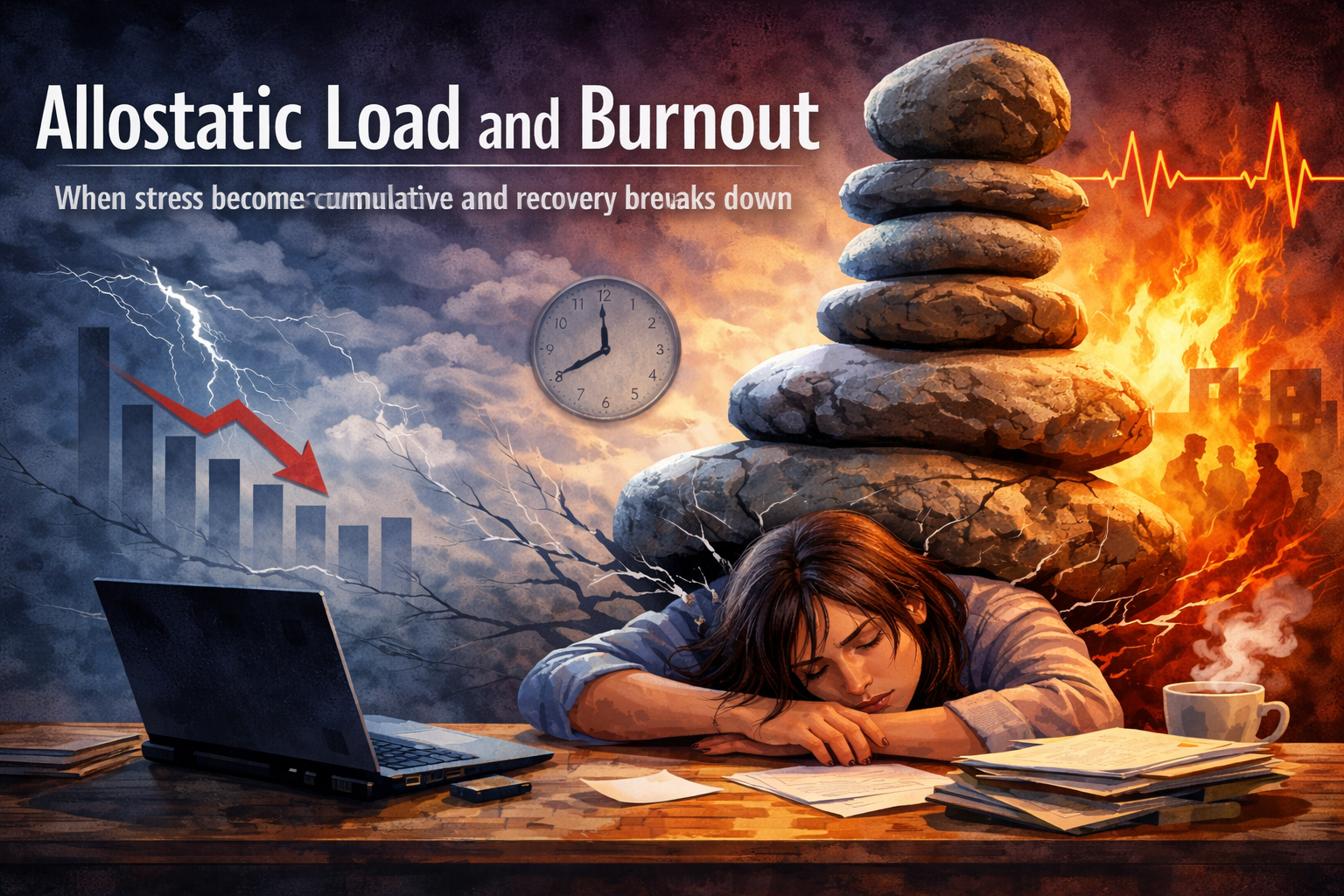
When stress becomes cumulative and recovery breaks down
Part 3 of the Science of Stress & Recovery series
Most people think of stress as something that happens in the moment — a bad day, a deadline, a conflict. But the body keeps a running total.
Every stressor you experience — physical, emotional, psychological — requires a physiological response. When those responses happen too often, last too long, or occur without adequate recovery, the cost accumulates. In medicine, this accumulating burden is called allostatic load, and it is one of the most important concepts in understanding why chronic stress eventually leads to illness, fatigue, and burnout.
1. What Is Allostatic Load?
Your body is designed to adapt to stress. When a challenge arises — whether it's a hard training session, a tense conversation, or a disrupted night of sleep — your nervous system, hormones, and immune system all shift to help you cope. This adaptive process is called allostasis, meaning "stability through change" (McEwen & Stellar, 1993).
The problem isn't the response itself. The problem is what happens when these responses are activated too frequently, sustained too long, or never properly switched off.
Allostatic load refers to the cumulative biological cost of this repeated or prolonged stress activation. Think of it as "wear and tear" across multiple systems — your cardiovascular system, your metabolism, your immune function, and your brain (McEwen, 1998).
Over time, this load shifts the body's baseline. What was once an emergency response becomes the new normal — and that new normal slowly erodes health.
2. How Allostatic Load Builds
Allostatic load doesn't accumulate from one bad week. It builds through patterns — often ones that feel routine.
There are several recognised pathways through which load increases (McEwen, 1998):
- Repeated activation — frequent stress responses without enough recovery between them
- Failure to shut off — the stress response remains elevated even after the stressor has passed
- Inadequate response — the system under-responds to stress, forcing other systems to compensate
- Lack of habituation — the body fails to adapt to repeated exposure to the same stressor
In practice, this might look like someone who exercises intensely without rest days, sleeps poorly for months, manages a high-pressure job, carries emotional stress from relationships, and pushes through fatigue with caffeine. No single element is catastrophic — but together, they compound.
3. What the Body Looks Like Under Load
Allostatic load is not a single lab result. It is a pattern of multi-system strain that emerges across several biological domains.
Research has identified changes in multiple areas (Guidi et al., 2021; Juster et al., 2010):
Hormonal dysregulation
- Elevated or blunted cortisol patterns (especially a flattened cortisol awakening response)
- Reduced DHEA-S (a protective counter-regulatory hormone)
Immune system changes
- Elevated inflammatory markers such as C-reactive protein (CRP) and interleukin-6 (IL-6)
- Reduced immune resilience and increased susceptibility to illness
Cardiovascular strain
- Elevated resting heart rate and blood pressure
- Reduced heart rate variability (HRV) — a marker explored in detail in Part 1 of this series
Metabolic disruption
- Insulin resistance and elevated blood glucose
- Increased abdominal fat storage
- Altered cholesterol profiles
These changes often occur below clinical thresholds — meaning standard blood tests may appear "normal" while the body is already under significant cumulative strain.
4. The Connection Between Allostatic Load and Burnout
Burnout is not just a psychological state. It is increasingly understood as a condition with measurable physiological features — and allostatic load may be the mechanism that connects chronic stress to burnout's physical symptoms (Bärtl et al., 2022).
In a strictly defined study from the Regensburg Burnout Project, individuals meeting clinical criteria for burnout demonstrated higher allostatic load scores compared to healthy controls. This was reflected not in any single biomarker, but in the cumulative pattern across neuroendocrine, immune, metabolic, and cardiovascular systems (Bärtl et al., 2022).
A 2025 scoping review of over 2,000 studies confirmed that chronic stress and clinical burnout are consistently associated with HPA-axis dysregulation, immune impairment, autonomic imbalance, and elevated allostatic load (van der Kolk et al., 2025).
Burnout, in this framework, is not a sign of personal weakness. It is the physiological consequence of sustained allostatic overload — when the body's recovery systems have been overwhelmed for too long.
5. Why Burnout Feels the Way It Does
Understanding allostatic load helps explain why burnout produces such a wide range of symptoms — not just mental exhaustion, but a whole-body experience.
Common features of burnout under high allostatic load include:
- Persistent fatigue that sleep does not resolve
- Emotional flatness or irritability
- Reduced motivation and engagement
- Poor concentration and memory
- Frequent illness or slow recovery from minor infections
- Muscle tension, headaches, or digestive issues
- Declining exercise tolerance
- Sleep disruption despite exhaustion
These symptoms arise because multiple systems are simultaneously dysregulated. As explored in Part 2 of this series, sleep — the body's primary recovery system — is often one of the first casualties of sustained stress, which further accelerates allostatic load.
6. The Role of HRV in Detecting Cumulative Load
As discussed in Part 1 of this series, heart rate variability (HRV) reflects the nervous system's ability to shift between stress and recovery states.
Under increasing allostatic load, HRV typically declines — reflecting reduced parasympathetic tone and diminished recovery capacity. Research consistently links lower HRV to chronic stress, burnout symptoms, and autonomic dysregulation (Kim et al., 2018; Järvelin-Pasanen et al., 2018).
What makes HRV particularly valuable is its accessibility. Unlike cortisol or inflammatory markers, HRV can be tracked continuously using wearable devices, offering an early window into whether recovery is keeping pace with demand.
How to use HRV as an early warning signal:
- Track HRV trends over weeks and months, not individual readings
- Look for sustained downward trends or loss of normal day-to-day variability
- Correlate HRV patterns with sleep quality, training load, and subjective energy
- Use declining HRV as a prompt to increase recovery, not push harder
7. Reducing Allostatic Load: A Recovery-First Approach
Reducing allostatic load is not about eliminating stress. It is about restoring the balance between demand and recovery.
The most effective strategies focus on removing barriers to recovery and reducing unnecessary physiological activation.
Prioritise sleep consistency
As covered in Part 2, sleep is the body's primary window for parasympathetic restoration. Consistent sleep timing often matters more than duration alone.
Audit your total stress load
Stress is additive. Work pressure, training intensity, poor nutrition, sleep debt, emotional conflict, and even excessive screen time all contribute. Reducing load in one area creates space for recovery in others.
Build recovery into your daily rhythm
Recovery is not just rest days or holidays. It includes micro-recovery throughout the day — brief breathing practices, movement breaks, time outdoors, and genuine downtime in the evening.
Reduce inflammatory inputs
Highly processed diets, excess alcohol, and chronic sleep restriction all drive low-grade inflammation that compounds allostatic load. Small, consistent dietary improvements have a measurable effect over time.
Use movement wisely
Exercise is a powerful health tool, but under high allostatic load, intense training can add strain rather than relieve it. Prioritise lower-intensity movement — walking, gentle cycling, mobility work — until recovery capacity improves.
Strengthen nervous system flexibility
HRV training, as introduced in Part 1, is one of the most direct ways to improve autonomic recovery capacity. Even 5–10 minutes of slow, paced breathing per day supports parasympathetic tone and reduces baseline stress activation.
8. When to Seek Support
Allostatic load operates on a spectrum. Early-stage load may respond well to lifestyle adjustments alone. But sustained overload — especially when accompanied by persistent symptoms of burnout — may require more targeted support.
Signs that professional guidance may be helpful include:
- Fatigue that persists despite adequate sleep and rest
- Symptoms worsening despite lifestyle changes
- Cognitive difficulties affecting daily function
- Emotional numbness or sustained low mood
- Measurable changes in metabolic, hormonal, or inflammatory markers
Functional and integrative medicine approaches can assess cumulative load through targeted pathology — including cortisol rhythm testing, inflammatory markers, metabolic panels, and HRV analysis — to identify which systems are under the most strain and where recovery support is most needed.
9. The Big Picture
Stress is not the enemy. Unrecovered stress is.
Allostatic load is the framework that explains why two people can face similar challenges, yet one stays well while the other burns out. The difference lies not in the stress itself, but in whether the body is given enough opportunity to recover, repair, and reset.
Burnout is not a failure of willpower or character. It is the predictable outcome of sustained physiological overload without adequate recovery.
The good news is that allostatic load is modifiable. Every improvement in sleep, every reduction in unnecessary stress, every moment of genuine recovery shifts the balance back toward health.
Within this series, Part 1 introduced the nervous system and HRV as the foundation of stress and recovery. Part 2 positioned sleep as the master recovery system. This article explains the cumulative cost of chronic stress and how burnout develops when recovery breaks down. Future articles will explore exercise as both stress and recovery, and the daily habits that protect long-term resilience.
Small, consistent recovery habits are not a luxury. They are the primary defence against the hidden cost of modern life.
References
- McEwen, B. S., & Stellar, E. (1993). Stress and the individual: Mechanisms leading to disease. Archives of Internal Medicine, 153(18), 2093–2101.
- McEwen, B. S. (1998). Stress, adaptation, and disease: Allostasis and allostatic load. Annals of the New York Academy of Sciences, 840(1), 33–44.
- Guidi, J., Lucente, M., Sonino, N., & Fava, G. A. (2021). Allostatic load and its impact on health: A systematic review. Psychotherapy and Psychosomatics, 90(1), 11–27.
- Juster, R. P., McEwen, B. S., & Lupien, S. J. (2010). Allostatic load biomarkers of chronic stress and impact on health and cognition. Neuroscience & Biobehavioral Reviews, 35(1), 2–16.
- Bärtl, C., Henze, G. I., Gianferante, D., Wudy, S. A., Kuebler, U., Rothe, N., ... & Kudielka, B. M. (2022). Higher allostatic load in work-related burnout: The Regensburg Burnout Project. Psychoneuroendocrinology, 143, 105853.
- van der Kolk, N., et al. (2025). Chronic stress in relation to clinical burnout: An integrative scoping review of definitions and measurement approaches. Frontiers in Psychology, 16, 1712340.
- Kim, H. G., Cheon, E. J., Bai, D. S., Lee, Y. H., & Koo, B. H. (2018). Stress and heart rate variability: A meta-analysis and review of the literature. Psychiatry Investigation, 15(3), 235–245.
- Järvelin-Pasanen, S., Sinikallio, S., & Tarvainen, M. P. (2018). Heart rate variability and occupational stress: A systematic review. Industrial Health, 56(6), 500–511.
- Juster, R. P., Sindi, S., Marin, M. F., Perna, A., Hashemi, A., Pruessner, J. C., & Lupien, S. J. (2011). A clinical allostatic load index is associated with burnout symptoms and hypocortisolemic profiles in healthy workers. Psychoneuroendocrinology, 36(6), 797–805.
- Ganzel, B. L., Morris, P. A., & Wethington, E. (2010). Allostasis and the human brain: Integrating models of stress from the social and life sciences. Psychological Review, 117(1), 134–174.